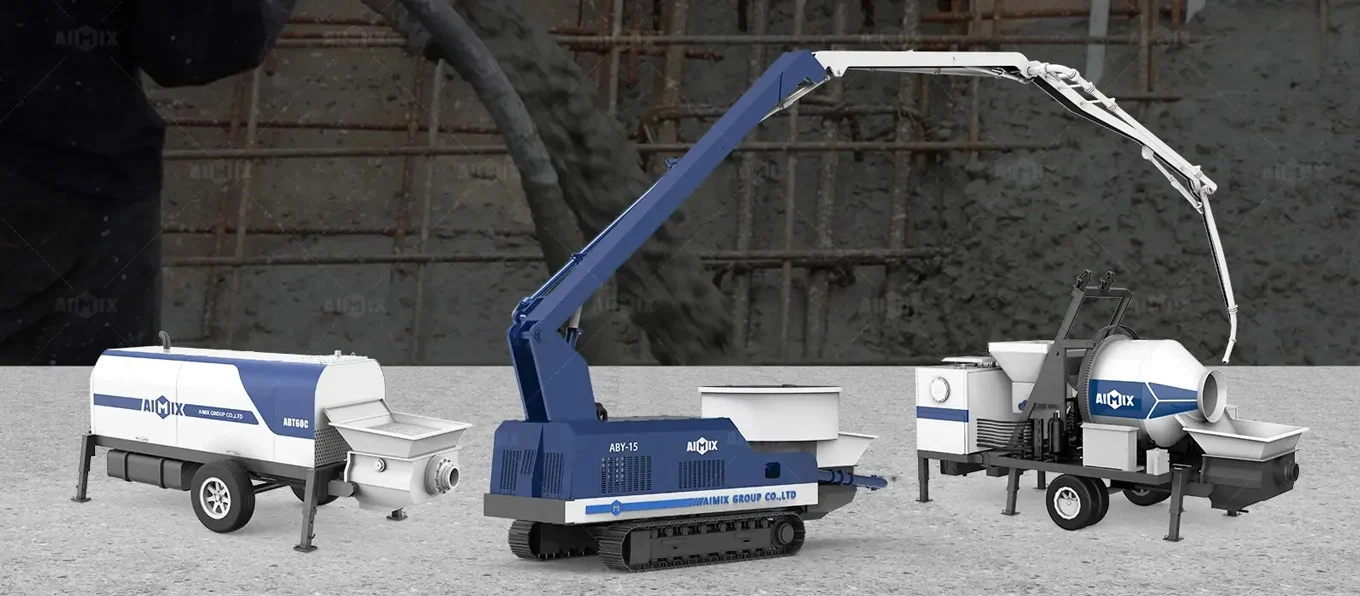
Choosing a concrete pump in Peru requires matching the pumping equipment to local project conditions, from urban building construction in Lima and coastal cities to road and tunnel projects across the Andes and mining developments in remote areas. AIMIX provides concrete pumping solutions for these applications, with equipment capacities ranging from approximately 40 to 120 m³/h. With a local office in Peru, AIMIX offers closer support for equipment selection, purchasing, and project coordination. Available options include concrete trailer pumps for long-distance pipeline delivery, concrete mixer pumps for on-site mixing and pumping, and concrete boom pumps for direct concrete placement. Each solution can be selected according to project scale, pouring height, pumping distance, site accessibility, and concrete supply requirements.
Different Concrete Pump Solutions in Peru for Your Project
From pipeline concrete delivery for building foundations and tunnels to on-site mixing and pumping for remote construction sites, different projects require different equipment configurations. Explore the following AIMIX concrete pump solutions to compare their working, key features, and suitable applications before choosing the right equipment for your project in Peru.
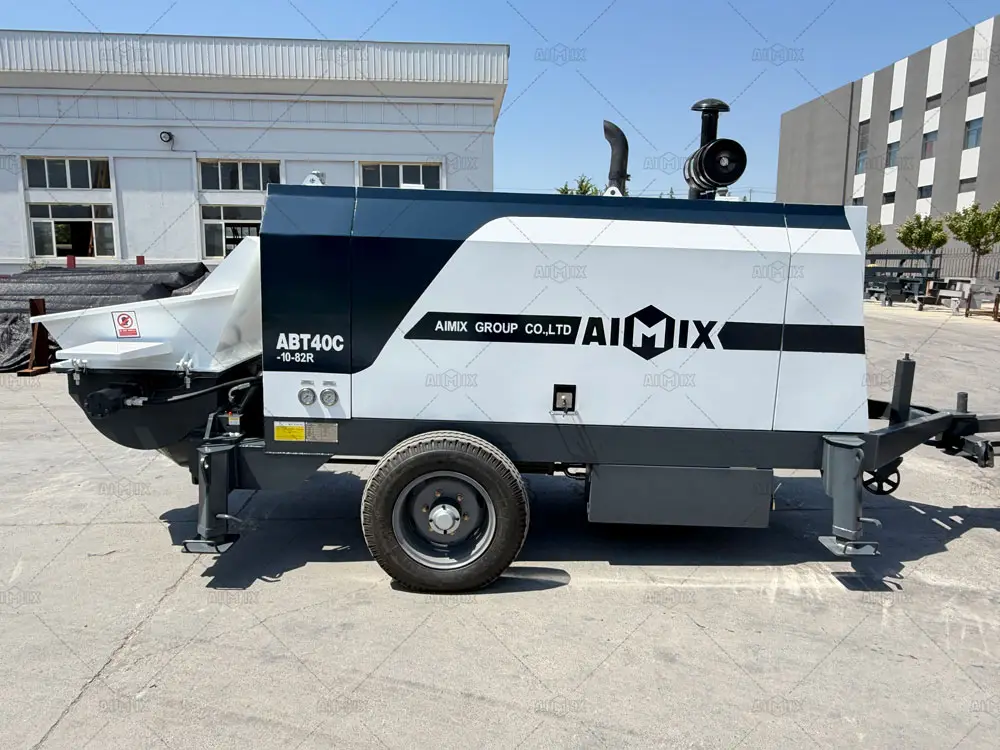
Concrete Trailer Pump for Pipeline Concrete Delivery
- Pumping Capacity: 30–80 m³/h
- Pumping Distance: 500–1,200 m horizontal delivery; 120–260 m vertical delivery
- Site Advantages: Trailer-mounted design allows transportation between construction sites, while pipeline layouts deliver concrete to locations beyond the pump’s immediate position.
- Suitable Projects in Peru:
Multi-story residential and commercial buildings in Lima and other urban areas.
Road tunnels, bridges, and transport infrastructure in the Andes.
Mining facilities, equipment foundations, and industrial construction in regions such as Arequipa and Apurímac.
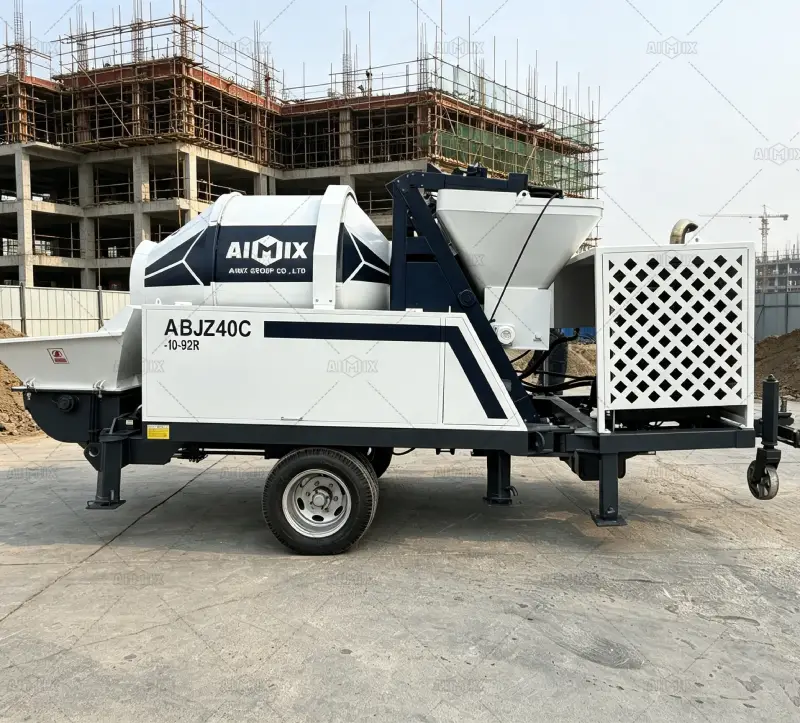
Concrete Mixer Pump for On-Site Concrete Mixing and Delivery
- Pumping Capacity: 30–40 m³/h
- Pumping Distance: 300–600 m horizontal and 100–150 m vertical
- Site Advantages: Produces concrete on-site and pumps it directly to the pouring location, helping contractors manage concrete supply without relying entirely on external ready-mix deliveries.
- Suitable Projects in Peru:
Rural housing, community buildings, and small commercial construction outside major cities.
Irrigation channels, retaining walls, drainage works, and other small-scale infrastructure.
Mining support facilities and construction sites where ready-mix concrete delivery is difficult to coordinate.
Concrete Boom Pump for Direct Concrete Placement
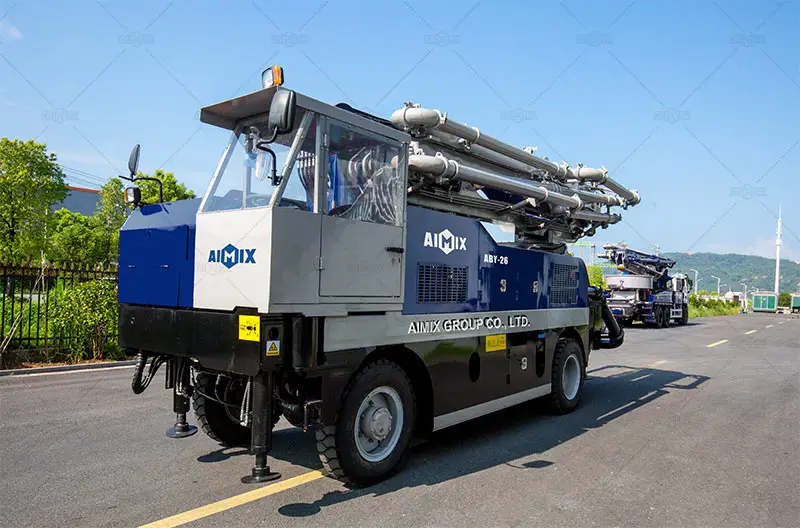
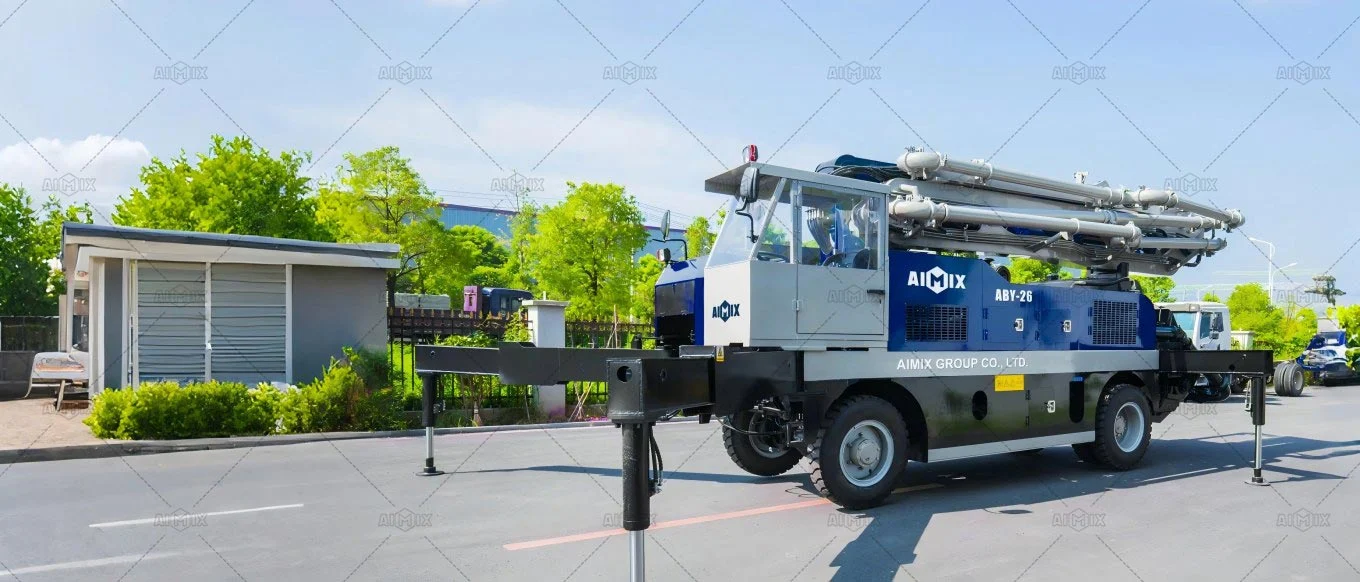
Wheeled Boom Pump and Mixer – ABY20 & ABY26
- Models: ABY20 and ABY26
- Boom Length: 20 m and 26 m boom configurations
- Maximum Capacity: 89 m³/h
- Integrated Mixing System: Equipped with a planetary mixer to prepare concrete on-site and pump it directly to the pouring area
- Mobility & Operation: Wheeled chassis supports movement between accessible construction sites, making it suitable for projects that require frequent relocation
- Suitable Projects in Peru:
Residential and commercial building construction in Lima and other urban areas
Industrial buildings, warehouses, and factory foundations
Drainage channels, retaining structures, and road-related concrete works in accessible construction areas
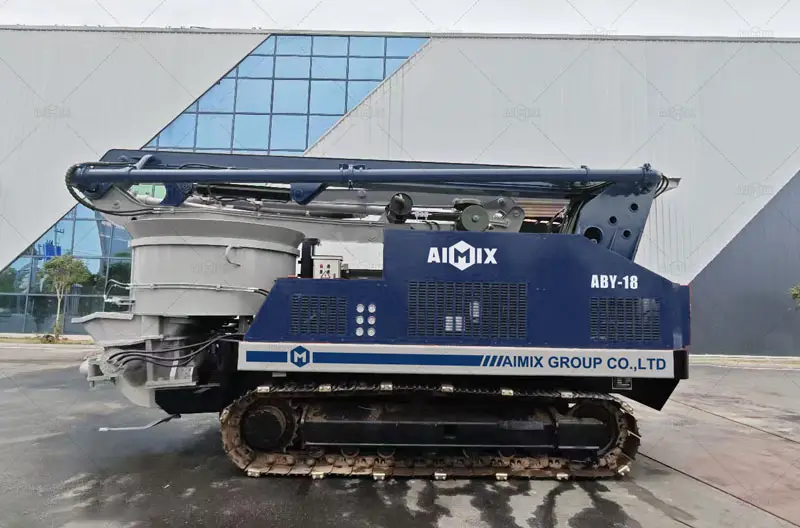
Crawler Boom Pump and Mixer – ABY15 & ABY18
- Models: ABY15 and ABY18, equipped with a crawler chassis
- Capacity: Maximum concrete output of up to 50 m³/h
- Boom Length: Available with 15 m and 18 m boom configurations
- Integrated Mixing System: Uses a planetary mixer for on-site concrete preparation and direct pumping through the placing boom
- Mobility & Operation: Crawler tracks support movement over suitable uneven or soft construction ground. Remote control is available for machine operation
- Suitable Projects in Peru:
Mountain road construction and bridge foundations in the Andes
Mining support facilities and concrete structures on uneven mine sites
Rural irrigation channels, drainage works, and slope protection projects
Construction Conditions & Concrete Pumping Challenges in Peru
Peru’s diverse terrain and regional construction conditions affect concrete transportation, equipment access, and on-site pumping operations. Contractors need to account for these factors when planning concrete placement.
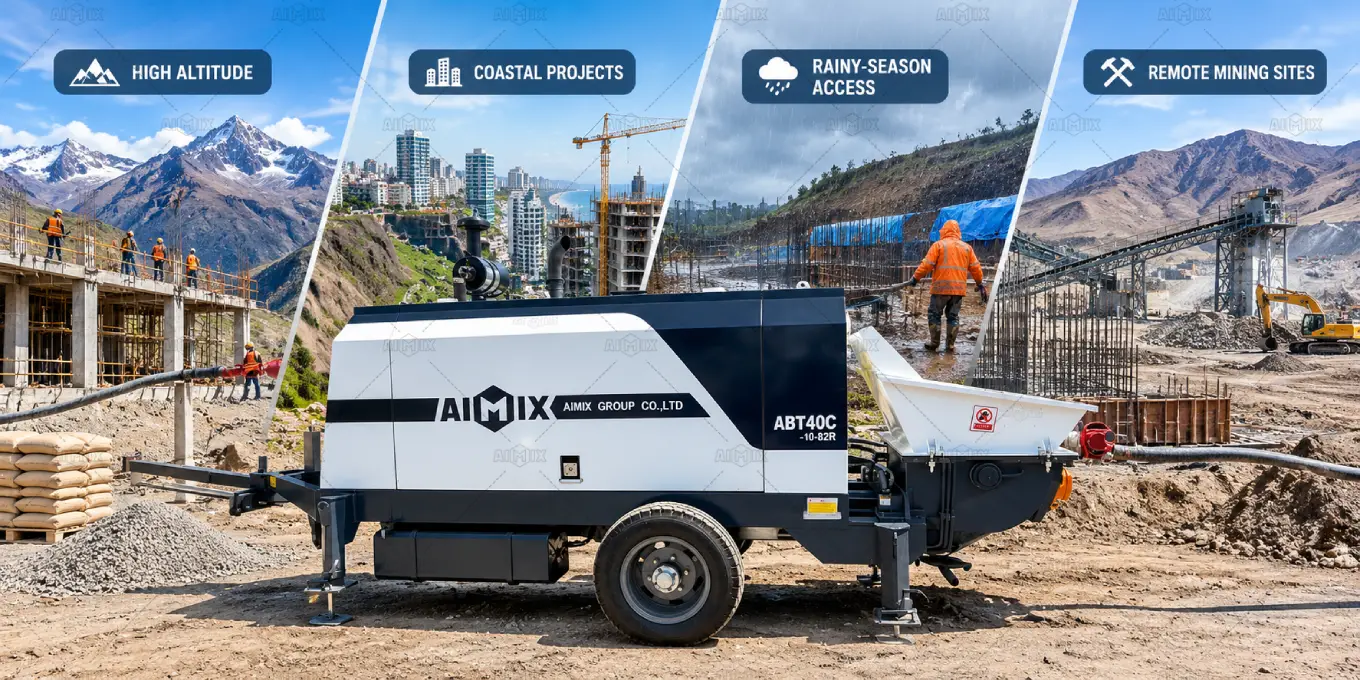
Coastal, Andean and Amazonian Construction Environments
- Coastal Areas: Urban building and industrial projects in Lima and other coastal cities often require efficient equipment positioning in relatively confined construction sites.
- Andean and Amazon Regions: Mountainous terrain, remote project locations, and difficult road access can complicate equipment transportation and concrete delivery.
Concrete Pumping in High-Altitude Areas
- Engine Performance: High elevations in the Andes can reduce diesel engine power due to lower air density. Equipment performance should be checked against the actual working altitude.
- Pumping Requirements: Mountain infrastructure and mining projects may involve long pipelines and significant vertical delivery distances, requiring suitable pumping pressure.
Rainy-Season Construction and Difficult Site Access
- Road Conditions: Seasonal rainfall, particularly in the Andes and Amazon regions, can make unpaved roads muddy and delay equipment and material transportation.
- Site Preparation: Wet or uneven ground requires proper drainage, ground preparation, and stable equipment positioning before pumping.
Concrete Supply Challenges in Remote Mining and Infrastructure Projects
- Limited Ready-Mix Access: Remote mining sites, tunnels, and rural infrastructure projects may be far from commercial concrete suppliers, making regular concrete delivery difficult.
- On-Site Production: Contractors may need concrete mixing and pumping equipment to maintain a more reliable supply near the pouring location.
Concrete Pump Solutions for Different Construction Applications in Peru
Different construction projects in Peru require different concrete pumping solutions. The following comparison shows suitable equipment types for common building, infrastructure, mining, and remote construction applications for reference.
| Project Type | Recommended Concrete Pump | Main Application |
|---|---|---|
| Residential & Commercial Buildings | Concrete Trailer Pump; Wheeled Boom Pump (ABY20/ABY26) | Pipeline delivery to foundations and upper floors of residential buildings, hotels, and commercial complexes in Lima, Arequipa, and other urban areas. |
| Roads, Bridges & Tunnels | Concrete Trailer Pump; Crawler Boom Pump (ABY15/ABY18) | Concrete delivery for mountain road tunnels, bridge foundations, retaining walls, and transport infrastructure across the Andes. |
| Mining & Industrial Projects | Concrete Trailer Pump; Crawler Boom Pump; Concrete Mixer Pump | Concrete placement for mining equipment foundations, processing plants, workshops, and industrial facilities in mining regions such as Arequipa and Apurímac. |
| Remote & Rural Construction | Concrete Mixer Pump; Self Loading Mixer + Concrete Trailer Pump | On-site concrete production and pumping for rural housing, irrigation channels, drainage systems, and small bridges in remote Andean and Amazonian communities. |
Two On-Site Concrete Production and Pumping Solutions for Peru
For construction projects in Peru where ready-mixed concrete delivery is limited, difficult to coordinate, or unsuitable for the site location, on-site concrete production and pumping can provide an alternative supply arrangement. AIMIX offers two solutions, one is the self loading concrete mixer in Peru paired with a separate concrete pump, and the other one is mobile batching plant with an integrated pumping system. Both solutions combine concrete production and delivery, but differ in equipment configuration, production workflow, and project requirements.
Solution 1: Separate On-Site Mixing and Concrete Pumping System
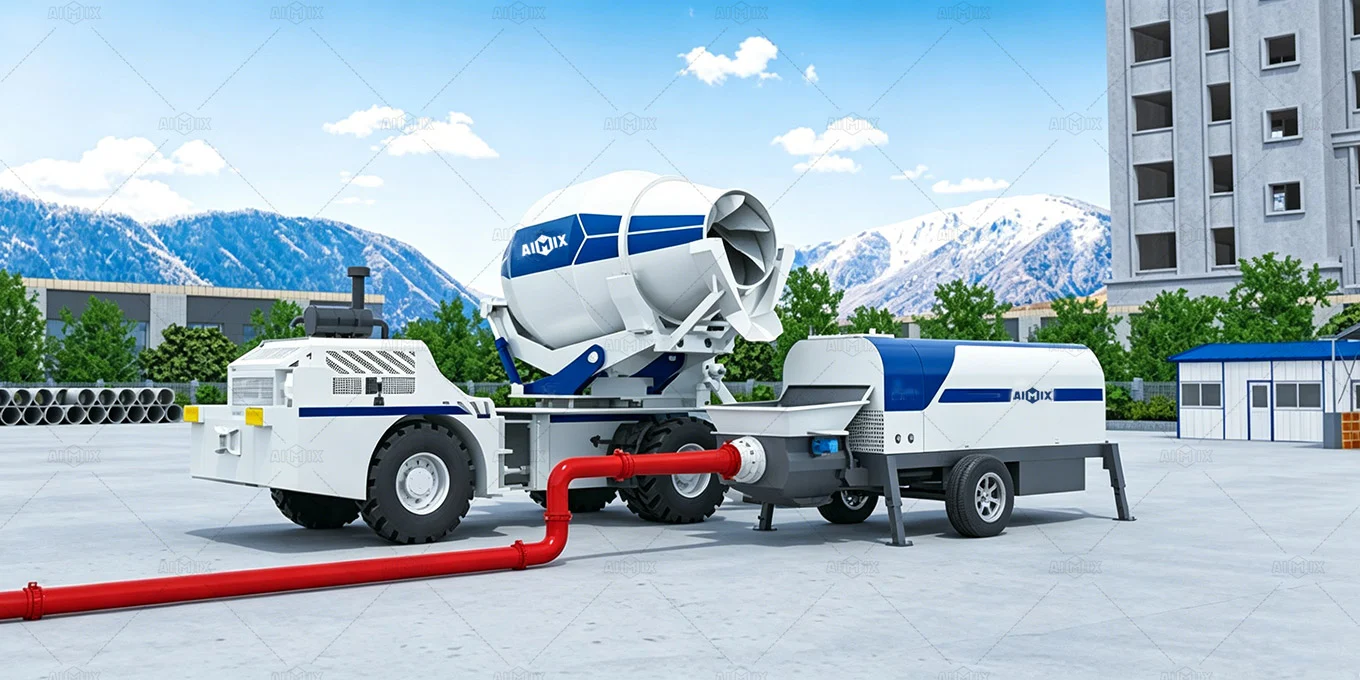
Combo Details
- Common Equipment Combo: AS-3.5 + ABT40; AS-4.5 + ABT40; AS-2.6 + ABT40; AS-5.5 + ABT60
- Working Process: The self loading mixer loads aggregates, weighs materials, mixes concrete, and discharges fresh concrete into the trailer pump hopper. The trailer pump then delivers it through pipelines to the required pouring location.
Benefits
- Load, weigh, and mix raw materials directly at the jobsite, reducing the need to transport ready-mixed concrete from a batching plant.
- The mixer can prepare concrete near the material storage area, while the trailer pump is positioned closer to the pouring point.
- Adjust concrete production to match the pump’s working pace and the project’s daily pouring schedule, helping avoid excess concrete production.
Applied for Projects:
- Remote mining support facilities in the Andes.
- Rural housing, irrigation, and drainage construction.
- Road and bridge projects with limited access to commercial concrete suppliers.
Solution 2: AJP40 Integrated Concrete Batching, Mixing and Pumping System
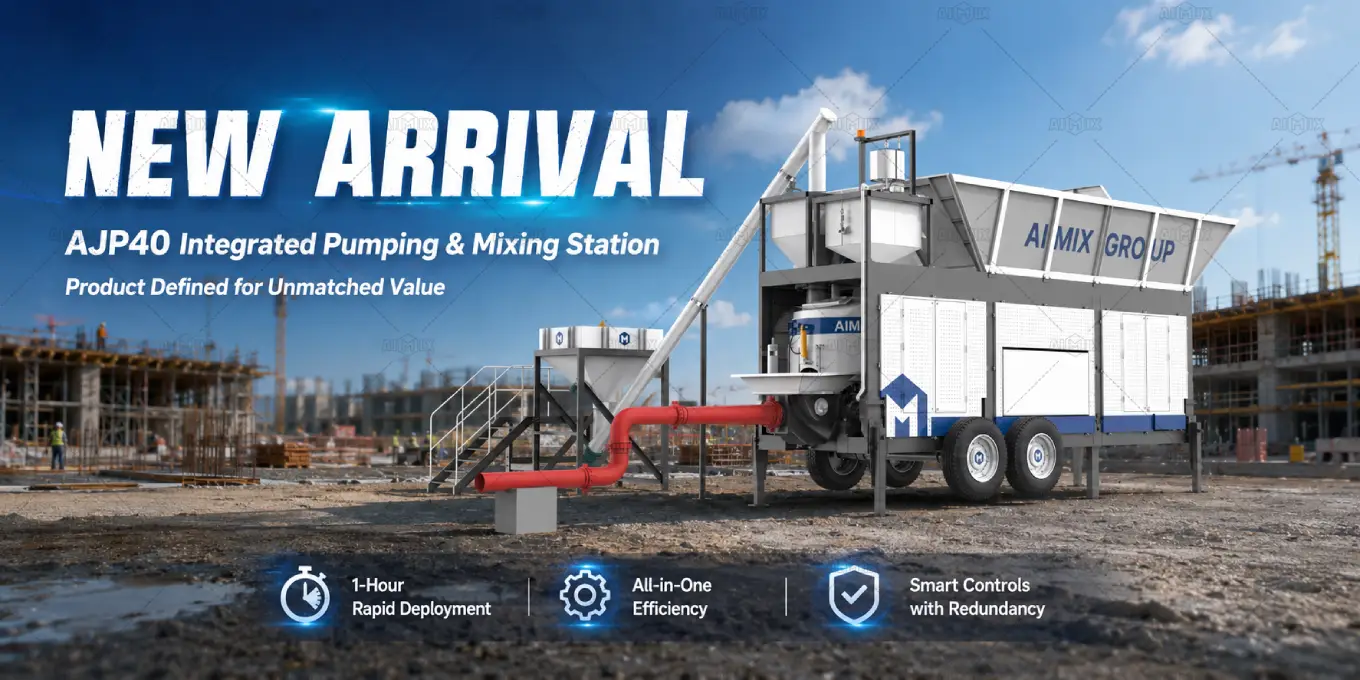
Product Details
- Equipment Configuration: Integrates aggregate batching, concrete mixing, and pumping functions on one mobile chassis.
- Working Process: Aggregates and other materials are batched and mixed within the unit, then the prepared concrete is pumped directly to the construction area.
Benefits
- AJP40 mobile batching plant and pump combines three functions in one machine, eliminating intermediate concrete transfer and improving operating efficiency.
- Uses a single chassis to reduce equipment transportation and on-site space requirements.
- Supports both generator and external power, adapting to different site power conditions.
Suitable Projects
- Small and medium-sized infrastructure projects in rural areas.
- Remote construction sites where a compact production and pumping arrangement is preferred.
- Projects requiring regular on-site concrete production without installing a conventional stationary batching plant.
Concrete Pump Equipment in Action Across Peru’s Construction Projects
AIMIX concrete pumps have been used in different construction projects in Peru, including residential construction, tunnel construction, mountain river works, factory building projects, etc.. The following cases show how different equipment combinations support concrete production and delivery under varying site conditions.
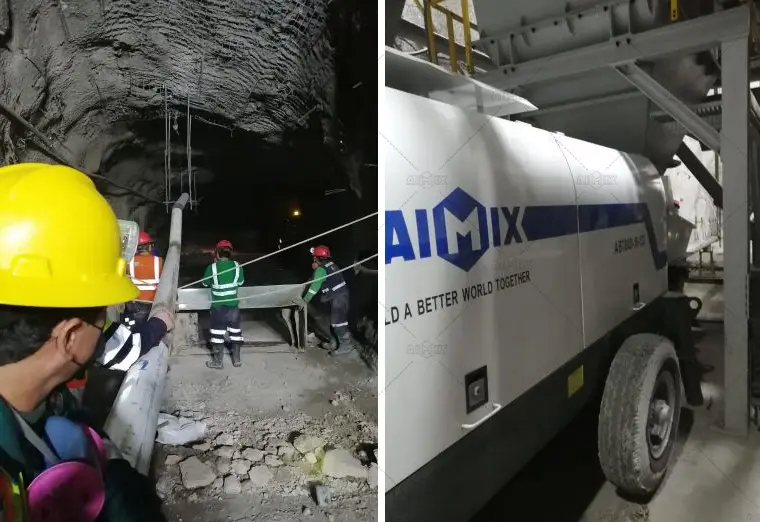
ABT80D Electric Concrete Pump for Tunnel Construction in Peru
- Project: Tunnel construction requiring long-distance concrete delivery through pipelines.
- Equipment Configuration: ABT80D electric concrete pump with a 110 kW motor.
- Pumping Capacity & Distance: 80 m³/h output; maximum theoretical delivery distance of 200 m vertically and 1,000 m horizontally.
- Project Result: The project was expected to be completed three months ahead of schedule, helping accelerate overall construction progress.
ABT40 Concrete Trailer Pump + AS-3.5 Self-Loading Mixer for Mountain River Construction
- Project: River construction in a mountainous area with challenging site access.
- Equipment Configuration: ABT40 concrete trailer pump paired with an AS-3.5 self loading concrete mixer.
- Concrete Production & Pumping: The AS-3.5 mixes concrete on site and supplies it to the ABT40 for pipeline delivery.
- Project Result: Enabled concrete production and pumping at the mountainous site without relying on ready-mix deliveries from distant suppliers.
ABT30 Diesel Concrete Pump + AS-4.5 Self-Loading Mixer for Factory Building Construction
- Project: A factory construction project required a coordinated solution for on-site concrete production and delivery during construction.
- Equipment Configuration: ABT30 diesel concrete trailer pump paired with an AS-4.5 self-loading concrete mixer.
- Concrete Production & Pumping: The AS-4.5 prepares concrete on site, while the ABT30 pumps it to the required pouring locations.
- Project Result: Supported concrete placement across factory construction sections with a coordinated on-site mixing and pumping process.
How Much Does a Concrete Pump Cost in Peru?
The price of a concrete pump in Peru generally ranges from US$16,000 to US$100,000, depending on the equipment type, pumping capacity, configuration, and boom length. The following price guide compares the estimated costs of different AIMIX concrete pump models to help contractors evaluate suitable options for their projects.
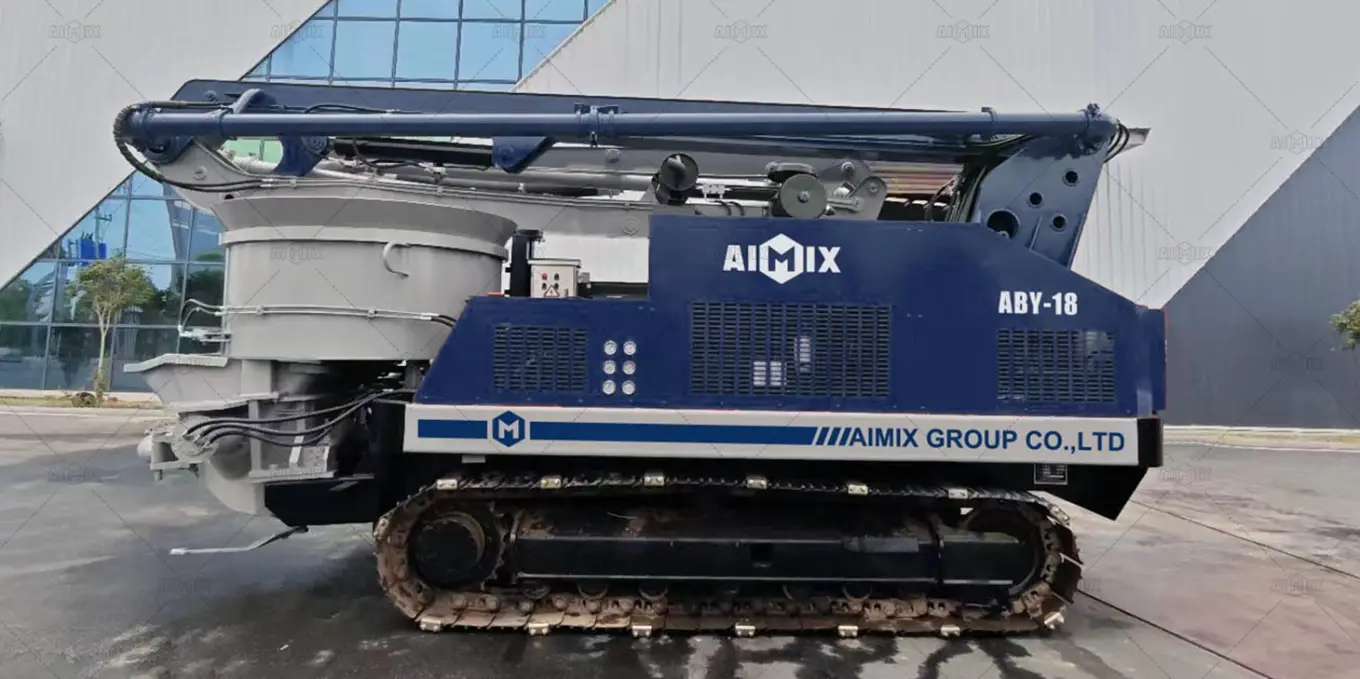
Concrete Pump Price by Equipment Type
| Concrete Pump Type | Price Range (USD) |
|---|---|
| Concrete Trailer Pump | US$16,000–62,000 |
| Concrete Mixer Pump | US$21,000–34,000 |
| Crawler Boom Pump (15–26 m) | US$72,000–100,000 |
Note: These are indicative equipment price ranges, not fixed quotations. The final concrete pump price depends on the selected model, technical configuration, and optional accessories.
What Affects the Final Concrete Pump Price in Peru?
- Pumping Capacity: Higher-output pumps generally require larger pumping systems and more powerful drive units.
- Equipment Configuration: Diesel or electric power, trailer or crawler chassis, and integrated mixing functions affect the equipment price.
- Boom Length: For crawler boom pumps, longer boom configurations generally involve higher equipment costs.
- Spare Parts and Accessories: Pipeline sections, pipe clamps, wear parts, and additional accessories may increase the order value.
- Shipping and Import Costs: Freight, insurance, customs duties, import taxes, and inland transportation in Peru should be considered when calculating the total landed cost.
To receive an accurate quotation, provide the required pumping capacity, concrete delivery distance, power preference, and project location. AIMIX can recommend a suitable model and prepare a quotation based on your equipment configuration and shipping requirements.
How Much Does It Cost to Maintain a Concrete Pump in Peru?
The maintenance cost of a concrete pump in Peru depends on operating hours, pumping frequency, working conditions, and replacement parts. The main expenses include wear parts, hydraulic system maintenance, and routine cleaning. Regular inspections and proper operation can help reduce unexpected repairs and equipment downtime.
Concrete Pump Wear Parts
- Common wear parts include wear plates, cutting rings, delivery cylinder seals, and concrete delivery pipes. These components gradually wear out during pumping and need to be inspected and replaced according to their actual condition and operating intensity.
Hydraulic System Maintenance
- The hydraulic system requires regular inspection to maintain stable pumping performance. Key maintenance tasks include checking hydraulic oil levels, replacing filters, inspecting hoses and connections, and monitoring system temperature and pressure. Following the manufacturer’s maintenance schedule helps prevent unnecessary repair costs.
Daily Cleaning and Routine Maintenance
- After each operation, operators should clean the concrete hopper and delivery pipeline to prevent hardened concrete from causing blockages. Regularly checking lubrication points, electrical connections, hydraulic components, and pipeline joints also helps identify potential problems early.
How to Reduce Concrete Pump Maintenance Costs?
Contractors can control maintenance expenses by:
- Selecting a pump model that matches actual project requirements.
- Using concrete mixes that meet the pump’s specifications.
- Cleaning the pumping system after every operation.
- Replacing worn parts before they cause further damage.
- Keeping commonly used spare parts available at the jobsite.
With a local office in Peru, AIMIX provides customers with a local contact point for equipment inquiries and purchasing coordination. Customers can also request spare parts information, replacement part specifications, and technical guidance to support routine concrete pump maintenance.